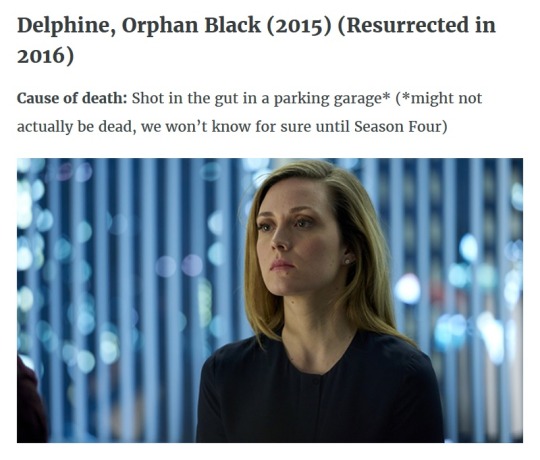
I heard a few of the ecstatic cries of “Delphine lives!” that
echoed ‘round the internets back in June, before I knew who Delphine was
or had any concrete plans of ever watching Orphan Black, so when I dove in a few months later, I was already aware of the following:
there was somebody named Delphine
at some point, she would appear to die
except not
I
wasn’t there for the Great Fandom Mutiny that erupted in the wake of
the season 3 finale. From where I was sitting, Delphine was only gone
for like two days, and there was never any doubt that she was coming
back. I can imagine how it might have felt to be left wondering about her fate for fifty-one weeks, but I can only imagine. The disappointment, the anguish, the sense of betrayal? I never got the chance to feel any of that.
Furthermore, there’s the issue of representation, which I like to think I
understand, but being a member of the most over-represented demographic
in the history of American/Canadian television, I’m aware that my
understanding is limited by the fact that it isn’t something I can experience.
I can denounce the constant killing of wlw characters on TV, both as a
trite, lazy cliché and as a harmful way to represent a marginalized
group, but I can’t know how it would affect me to have prime-time dramas
repeatedly reinforcing the idea that stories about people like me can
only end in tragedy. So I acknowledge that even if I had been there from
the beginning, Delphine’s shooting wouldn’t have had the same impact on
me that it had on much of the fandom.
All right, I’ve got the
disclaimers out of the way, now on to the point: in the debate over the
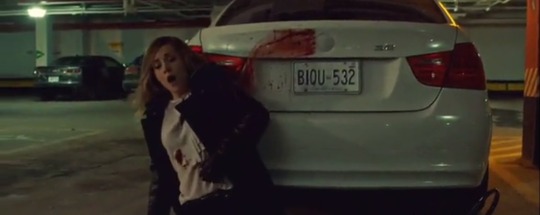
showrunners’ true intentions in the infamous parking garage
scene–whether Delphine was actually meant to die or not–I lean towards
believing the official line, which is that they planned to bring her
back all along. From a storytelling standpoint, it just doesn’t make
sense to have such a fan-favorite character die off-screen between
seasons, and then leave her fate unaddressed for so long. Confirming her
death nearly a year after she was shot–after so many viewers had given
her up for dead–would have had no real plot-twist value; it would have
been the very definition of anticlimactic.
Admittedly,
this is not an ironclad argument. It hinges upon the assumption that
Graeme Manson and John Fawcett do not have their heads up their asses,
and if there’s one thing I’ve learned from my multiple decades as a
watcher of TV, it’s that this can never be safely assumed about
television producers. Compound this with their unambiguous denial that
Evelyne Brochu would be returning for season 4, plus their tone-deaf
response to everyone who rebuked them for perpetuating the Bury Your
Gays trope (essentially “Yeah, but it was different when we did
it*”), and I can easily see where the other side is coming from. So for
those who are still angry about it, be angry; I’m not telling anyone
how to feel. If Delphine’s eventual return/resurrection was not
sufficient atonement in your book, that’s your business.
But I’m jealous. I wish I
could believe they meant for her to die. If they killed her off and
then caved to fan pressure to bring her back, do you know what that
means? It means they understand that they fucked up! It means they’ve learned that we will not stand for these shenanigans! It means Cophine is safe!
Or
maybe not. This theory, too, is dependent upon an uncertain assumption:
that the showrunners have managed to keep their heads out of their
asses ever since those heads were dislodged by the uproar over
Delphine’s apparent death. Still, I can’t help thinking that I’d be a
lot more optimistic about a Cophine happy ending if I believed Fawcett
and Manson had learned a lesson from all of this. If they always
intended to bring her back–as I suspect is probably the case–then what
lesson was there to learn?
*which, incidentally, is what all TV producers say when confronted about this
If I am perfectly honest I have never believed her to be dead and when people mourned her and I actually watched the episode all I could think was: “but we only see her getting shot, we do not see her die!!” and from a writer’s/showrunner’s point of view the only reason for that would be that there is more to the scene than her dying. Either something would have happened during or after her death that we would learn about later, returning to this scene and actually see her die OR she survives. TBH from that moment on when Evie Cho cold heartedly told Cosima that Delphine was dead WITHOUT the show turning back to this scene for further explanation of it, I honest to God was convinced it was a lie and that Delphine was alive. Because as I have said… I can’t for the life of me imagine filming a scene where a major character and fan favorite gets shot and doesn’t actually die on screen without any reason. And at this point it was clear they did not want us to, for instance, believe something wrong about the killer but that they wanted us and Cosima to believe that she is dead. And that the final revelation of the finished scene in the parking lot was that she wasn’t. As it turned out to be. However, this does not mean that they did not learn anything from the mess that other TV shows made last year. They did witness it after all, no matter what they did themselves. They could still see what happened to other shows and be smug that they did not go down this route and be ever the more convinced not to in the future….
I completely agree with all of this, which is exactly why I’m more upset about the way they handled what came after her “death” — which I consider outright bad writing (Felix forgetting to tell Cosima that he knew Delphine was alive wtf) — than with the death scene itself.
I was in the same boat with Delphine only being “dead” for 24h, being a way late bloomer within the cloneclub. I was spared the 51 weeks of pain and longing. I can understand the angst and hurt feels. Hell, I can’t stop thinking about the shot scene when walking in a car park (having a bisexual target on my back).
I agree with @seanpgilroy on theories that Delphine’s fake death could have been the original master plan all along (we *could* give them credit) OR that the #savedelphine outcry
(take note of season 4 viewer ratings fallout)
forced the execs/show writers to rethink the character and bring her back (the POWER to the fans!).
Either way, my heart just wants a happy Cophine but my brain screams: YOU FOOL! YOU’RE SETTING YOURSELF TO BE BURN!
I think that there is a bit of context that is missing from this conversation of which many people are not aware. There was a leaked photo of the OB writers’ room (distributed on Twitter and tumblr, I believe) in which notes were scrawled on a board about developing Cosima’s relationship with Shay into a full-on capital-S Ship/plot point, with no mention of Delphine. At the time, Evelyne Brochu’s popularity had begun to grow exponentially, and she had X Company happening. Rumours were also about that there were questions as to whether OB showrunners would be able to get her back at all, and that they were introducing the Shay character to be a substitute.
Now, rumours are rumours, and Q-ratings are what they are, but X Company was a fact, as was the writers’ room photo. These things combined to outline a scenario where OB would not get EBro back (due to her refusal, unavailability, or not wanting to negotiate and pay up for her) and thus would replace one blonde wlw character with another, as if the character itself was reducible to those traits. In which case, they would be doing wlw characters and fans a great disservice, and also just be effing lazy, as there would have been 99,000 better ways to write Delphine out and move Cosima’s character on from there. I mean, one can imagine the panic amongst showrunners at the thought of losing the popular, romantic ship (and character, in Delphine) that had become fan favourites and gotten them a lot of good press for being modern, feminist, etc., but using the old “It’s the same Darren” move from Bewitched would be treating the fans like idiots, as though all we cared about was seeing two women in general kiss.
So, with that info included, the fear/assumption that Delphine would not be back became much more realistic, and the fan reaction much more valid. Add to this the liberal doses of trolling the OB folks did to the fanbase, and I think you will understand the well of ire better. Would we like to believe the showrunners meant to bring back Delphine all along? Perhaps, although that wouldn’t excuse their dunderheaded handling of fans’ feeling on the matter. All things considered, we can’t really know. We do know, however, that they didn’t manage the situation well, and that they had Shay as a back-up plan, which they pretty much had to abandon whether they wanted to or not, once fans made it clear that one suddenly introduced love interest for Cosima was not interchangeable with another, established and brilliantly acted one. I think all this is part of what transformed what could have been a typical “whodunit/what’s next?” cliffhanger into a swell of fandom outrage. (Well, this and a lot of people reaching their limits of patience with BYG, which happened even more so with The 100.)
I’d like to underline @trylonandperisphere’s point about showrunner trolling – to me, this is the real problem. Ostensibly straight writers having a bit of ‘fun’ with their queer audience, teasing them over the possible death of a queer character – only to pull back and say, see? We’d never do that. It was deeply upsetting when Delphine was shot and whether they intended for her to die or not (I’m not convinced they had a lock on this scenario), they still toyed with their queer audience over it. They later made an ‘in memoriam’ video featuring Delphine – more ‘dark humour’ that felt like we were being made fun of. It was thoughtless and insensitive.
Doctor Who pulled this recently with Bill Potts, who was shot, killed, resurrected through ‘conversion therapy’ into a Cyberman – then ‘restored’ at the last possible second in a follow-up episode by a deus ex machina narrative. Her death was meant to shock – but all for a ‘laugh.’ If this is so funny, why aren’t we laughing? They turn our dread of this trope into a joke where only they get the punchline.
I doubt there is deliberate cruelty behind it – just an enormous amount of insensitivity toward an audience that no longer tolerates being messed with on the issue – playing the condescending patriarchal card where we really need to get over ourselves, it was just for fun, ffs.
This makes the Wynnona Earp team such a breath of fresh air – and shows the essential difference in a woke (female) team vs. an almost entirely male-run production. One laughs with us, as a friend – the other laughs in our general direction.
It’s usually forgotten that, for a time, Dawn had two mums.
Until one of them was killed and the other went mad with vengeance.
This might have been the first time a wider audience became aware of the Dead Lesbian Cliche.
I’ve too many ideas on the dead lesbian topic, so much of the fascination with it goes back decades, to 50s pulp fiction, to lesbian vampire stories and later films (probably the most responsible for romanticising the image).
In the past, the dead lesbians were villainous, predatory beings who ‘got what they deserved.’ In more recent media. starting in the 90s (when we saw the first major ‘coming out’ of well-known lesbians and gays), the imagery shifted from ‘villainous’ to ‘tragic’ characterisations, such as the lesbian founders of the fictional town of Cicely in an episode of Northern Exposure, or the heroic but ultimately tragic downfall of Xena, to the lovable and gentle Tara, victim of a stray bullet that helped push her girlfriend, the problematic anti-hero, Willow into broken villain territory.
Films like High Art with Ally Sheedy as a drug addicted photographer on a downward spiral and Lost and Delirious helped reinforce the tragic lesbian image: the troubled, lovelorn and usually misunderstood loner who cannot be with the one they love (or finds their love unrequited – another common thread).
We can make connections in real life: lesbians so often seen as something undesirable, preying on young girls, undeserving of love, on the receiving end of public violence. It’s as if media makers cannot see past this view, cannot think there are other ways to present lesbian lives.
Dramas like Chasing Amy frustrated lesbians and bisexuals with the characterisation of the allegedly lesbian (yet straight-presenting) cartoonist/writer who fell in love with a man (another common trope: the lesbian who just needs the love of a good man to see the error of her ways) and found herself ostracised by her friends and mocked by her boyfriend’s best friend (who doesn’t believe in ‘man-friendly lesbians’ there are only ‘man-hating dykes.’).
Again, we see the problematic view of straight versus our own, personal narratives that would offer a completely different take.
It’s hard to look at the romanticising of tragic lesbians without recognising that there is an element of the classic romanticising of tragic male heroes built-in. As if lesbians become a stand-in for the classic male hero who pines for a love that cannot be had and, possibly, dies in the end. There are many examples of male characters written in a similar fashion (it’s practically the history of all literature/film-making) and it speaks loudly that so many filmmakers/show runners who create a lesbian character/pairing, are straight (white) males. Instead of writing a lesbian as a lesbian, they write her as a the tragic male hero archetype.
It’s a powerful image, it is prevalent and systemic throughout all media and it is difficult to shake. We have women who write this trope. We have women writers who compose stories like Twilight and 50 Shades of Grey that romanticise abuse. Is it no coincidence that these type of stories get made into films while more direct lesbian narratives in fiction, like Malinda Lo’s Ash or Emma Donoghue’s Stir Fry do not? With the possible exception of Sarah Waters, lesbian writers do not typically see their lesbian-themed works on screen.
There is another, more uncomfortable angle of this problem (that would likely involve my doctoral thesis) that looks more broadly at women with mental illness and how they are perceived in society. Women who suffer from mental health disorders are rarely portrayed in the same light men suffering from similar issues or, say, PTSD are: how many films have been made about soldiers returning from war, behaving in violent, abusive or otherwise disturbing fashions are treated (and often rightly) with sensitivity and heroism, while women with similar issues are either non-existent or ignored.
Case in point: Willow, from Buffy the Vampire Slayer,
had been a somewhat insecure but brilliant and magical student who became Buffy’s ‘big gun’ when up against the hell god, Glory. She is on her way to hero-dom. Almost immediately thereafter she suffers from ‘magic addiction’ that leads her to mind-rape her girlfriend Tara, abuse her friends and, eventually, to murder. When Tara is killed, she goes on a murderous rampage that is only resolved when her (male) friend, Xander, is able to talk her out of it. She is later handed over to another male father-figure, Giles, who treats her gently, but with the kind of paternalistic heroism that deflates her considered prowess (and potential) into problematic territory where Willow becomes afraid to use her magic at all and once again becomes an insecure sidekick (albeit one with almost godlike powers).
Characters like Willow can drive home the point that no matter what do, what we are capable of, as women (and as lesbian/bisexuals), will always be secondary to our problematic emotional states that lead us down troublesome roads where a good man would really come in handy.
If there is to be a hero, someone must be rescued and, for the male-centric paradigm of our culture, that someone is preferred to be a female.
It goes hand-in-hand with my belief that a major reason we don’t see many female superhero action figures is that there is a perception that boys will not play with them. The reason we see girls dressed as male action heroes (for fun or Halloween) while boys are never seen dressed as female action heroes: women are not perceived as worthy as men for any significant social standing, least of all as cool heroes (that this perception revolves around so many young men and boys is also troubling).
For many years the programme Doctor Who teased the possibility of a female Doctor. This notion was vociferously put down by fans (largely male, but women too) and, I feel, an aspect of this is the same as written above: boys will not follow women and will not wear a woman hero’s costume, even for fun. The boys will dress up as boys and play with boy action figures, but they will not show the same respect for female figures. As marketing toward males is considered the strongest demographic, once again, women are belittled just for being women.
I know I’m writing this rather simplistically, but I feel much of this information is so broad anyway and so many citations are available almost anywhere. There are some common truths in our society: women CEOs are rare, women directors are not hired, lesbians are perceived through a male filter equating them with tragic and even mentally ill figures.
It makes programmes like The 100 so much more disappointing when, after achieving the astonishing feat of creating story lines for complex women as leaders and heroes, they begin to fall into the trap of ‘redistributing the wealth’ so that the (background) male characters may take centre stage and reaffirm their own complex hero status, usually at the expense of a female character’s development (see the troublesome nature of Clarke and Bellamy’s relationship).
We exist to be sidelined, the story seems to be and while I acknowledge that the world has made some extraordinary strides in its (evolutionary) understanding of women, on the small screen as well as globally, in real life, the formulae for success seems to point to male-centric demagoguery. Is there a more potent or disturbing example of this than, say, Donald Trump’s presidential campaign? We seem to have reached peak toxic maleness at this point.
We have made progress, though. Social media has helped open the hearts and minds of so many who would remain ignorant of the reality of female Muslims or the disabled or of transgender concerns. It doesn’t prevent backlash, of course. Trump would have Muslims banned. The disabled are so rarely seen in film or television (and when they are, they are usually portrayed by non-disabled actors). POCs are still singled out for murder by public authorities. LGBTQs are still seeking positive representation.
It is, therefore, heartening when audiences come together to complain about issues like queer baiting and lack of representation. It is heartening to see social media campaigns that call out the tokenism that is still rampant in our lives. We deserve better and we know it. We’re not settling for standard-issue formulaic drama that still promotes the hetero normative as positive while anything different is subject to trope-ish cliches. We are, rightly, demanding that the media world diversify and write better stories, not just the ones that highlight one portion of society as normal while everyone else becomes a controversial bystander.
I didn’t mean to rattle on, and hope some of this makes some kind of sense. Thanks for writing!


 The Doctor Is Out