some recent writer tweets about how “we just wrote our darkest episode yet!” lead me to believe jr actually doesnt care about any of the criticism. Why would he considering that the network boss is completely behind him and basically thinks he did nothing wrong. Likes him so much he gave him another show. Those people on twitter were all just really mean to him, that poor innocent angel. Anyway, lets torture clarke and raven 40 more times. Good TV! ART!

entirelytookeen:

Yeah, probably.

The people at Rothenberg’s level (showrunners, super successful writers, anyone famous enough to headline, etc) have the ability to create an echo chamber, surrounding themselves with people who will only back them up pr egg them on. If you’re not careful, or if you’re not respectful of other viewpoints (and given what we heard about the writers’ room…), you end up with no one who’s willing to step forward and confront their boss with constructive feedback or a challenge to their preconceptions. 

That’s how you go from being capable of very good work to churning out sludge. And television, like a lot of show business, is a lot about who you know and who you’re friends with, especially when it comes to who gets to be a showrunner, director, or producer. This isn’t a secret, many people who know a lot more about it than I do have spoken in intimate detail about how hard it is to break into the system, which is dominated by white men. 

And I bring that up because this kind of genre work – violent, nihilistic, hopeless – is especially beloved by white men. We had grimdark writers and shows before – we even had dystopias before The Hunger Games, there’s nothing new under the sun. But I believe we’re now drowning in that kind of material for very specific reasons. Certain types of fantasy enter mainstream popularity, I’m convinced, because of the shifts in cultural attitudes and understanding. Tolkienesque high fantasy was all the rage when Americans were convinced we’d traveled too far into modernity and political corruption; they wanted a vision of powerful nature and extreme nobility. Urban fantasy, which played with the synthesis of the natural (”real” world) and supernatural, peaked just as people were beginning to connect with each other in new and intimate ways via the internet and burgeoning social movements.   

And now we’re seeing the fantasy that’s popular in the aftermath of those movements, and it’s preoccupied with the end of the world. (Because of course calling attention to flaws in the system, like racism and transphobia and misogyny and homophobia, that’s going to bring it crashing down on our heads! You’re weakening the system by questioning it! Maybe the system is flawed, but without it there’s chaos!) It’s also fascinated with a vision of the apocalypse which still, somehow, bestows all advantage and privileges onto straight white men. Because even without the system in place, these creators kink on the idea that those privileges and advantages are inherent.

(And if it’s not post-apocalyptic, it’s somehow “way way back in the past,” but it’s still the same shit. And people call it “historical” and “realistic,” completely ignoring actual historical records or events that contradict them seven ways to Sunday.)

Yes, these creators believe they’re making good art, because it scratches their subconscious itch to think that the system which benefits them is all-enduring, whether we go deep into the past or are flung into the future. And creators like Rothenberg will call themselves “progressive” for putting someone other than a straight white man at the center of those stories, even though their never-ending suffering only reinforces the subtext that such characters shouldn’t really be the heroes, and they will be punished for thinking otherwise. 

That’s the art which resonates with them on a gut level. So they think it’s important, and they will keep making it. Despite what anyone else tells them.

If I appreciate anything that came out of the Lexa debacle, it’s the thoughtful and thought-provoking commentary, the challenge to the established order in an industry that really does have its head too far up its own straight white arse.  

yanderemoth:

Kinda fucked up how cis women are allowed to abandon feminity in the name of feminism but trans women are forced to adopt it just to be recognized as women

Femininity is just another social construct.

Here’s to women just being whatever the hell they want.

For inspiration reasons, here’s a list of actresses over 40 who can probably still kick our asses:

onthetracks11:

happilyshanghaied:

Kelly Hu (Age: 48)

image

Linda Hamilton (Age: 60)

image

Charlize Theron (Age: 41)

image

Gina Torres ( Age: 47)

image

Ming-Na Wen (Age: 52)

image

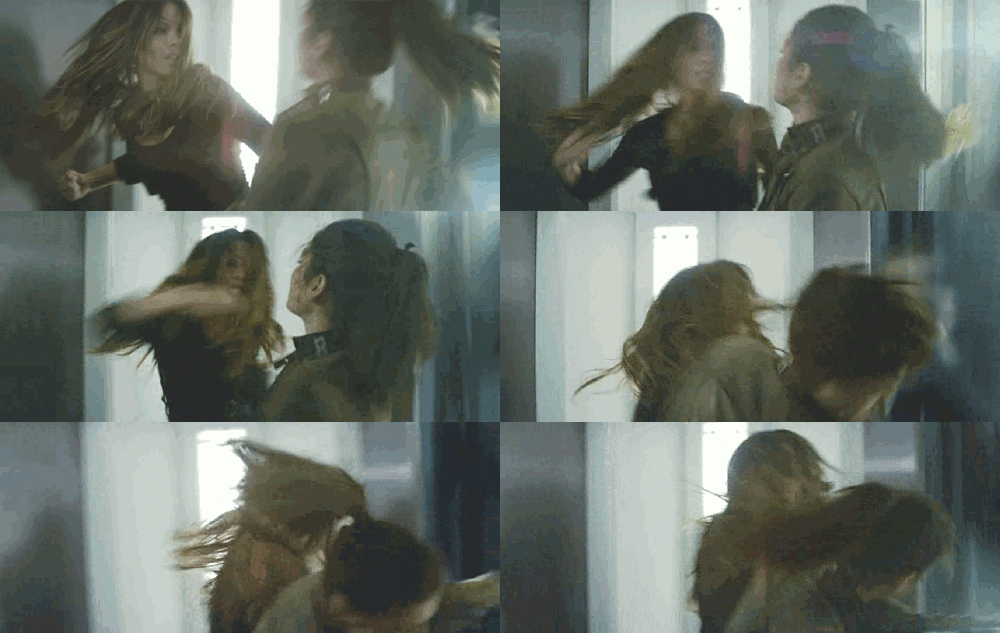
Kate Beckinsale (Age: 43)

image

Gwyneth Paltrow (Age: 44)

image

Milla Jovovich (Age: 41)

image

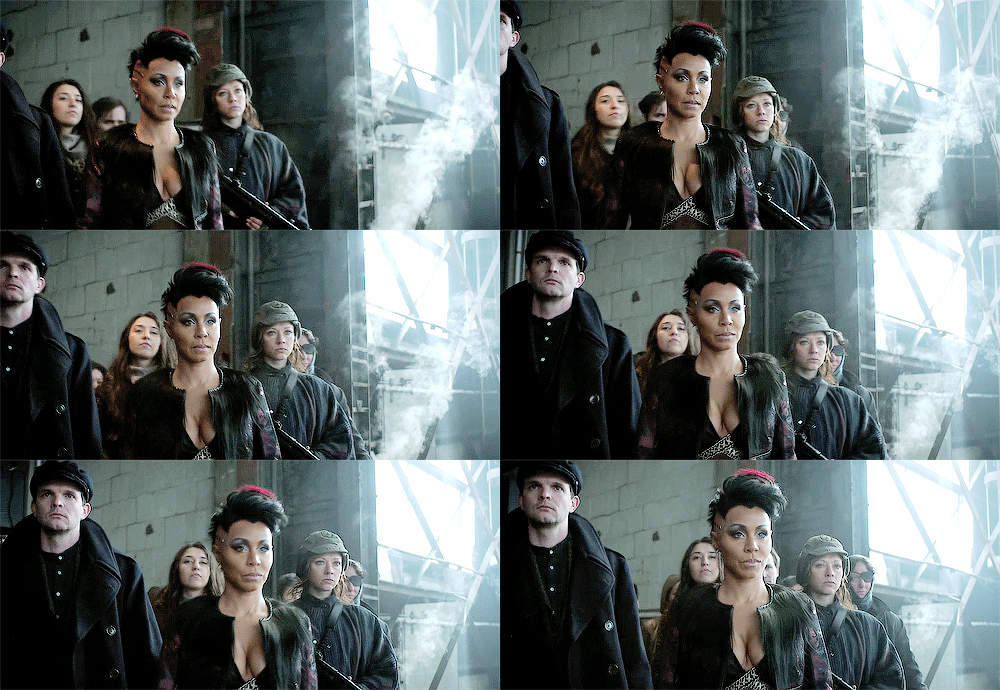
Jada Pinkett Smith (Age: 45)

image

Michelle Yeoh (Age: 54)

image

Lucy Lawless (Age: 48)

image

Regina King (Age: 45)

image

Lucy Liu (Age: 47)

image

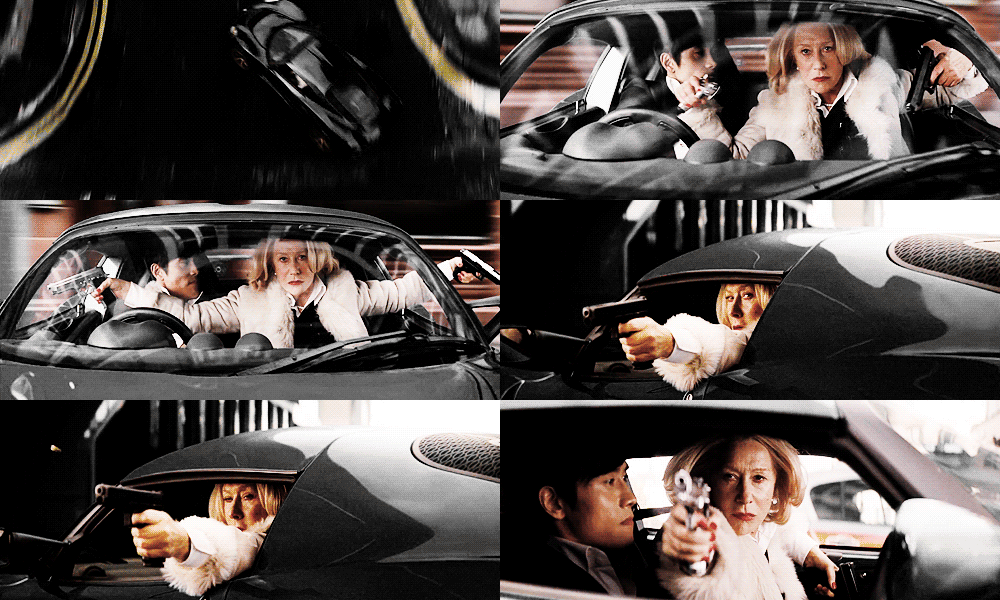
Helen Mirren (Age: 71)

image

My new favorite post.

Really bothers me that women in their 40s and 50s are considered ‘old’ especially for action roles, when men in that age group (and much older) are considered in their ‘prime’ for it. 

“I’ll decide when I get old. Not you.”

mellissa herself said plenty of times at comic con she didn’t like that superman was not in her story that it felt strange missing such a big part of karas life so why are you upset about superman being there? its only two episodes

laynemorgan:

badcode:

Regardless of how much or how little screen time he actually gets, the fact of the matter is that the first official promotional photos the CW has released for the season have been of Kara with Superman, and the vast majority of the press and publicity for the upcoming season has been centered around Superman, Tyler Hoechlin, how does Tyler Hoechlin feel about the suit, what advice did Supermans of franchises past give Tyler Hoechlin about being Superman / about manscaping / about peeing in the Superman suit, oh look iconic Superman villain Metallo (played by a pasty white dude), is Tyler Hoechlin’s Superman actually going to turn into an antagonist and is Mon-El (yet another white boy) here to help Kara fight him??? (regardless of the truth of that last one, it’s an article that was written, it’s indicative of how Superman fanboys are using this as an opportunity to take this show and MAKE it about Superman—make it about them—regardless of how much actual plot Clark is getting).

The point is it’s drawing attention away from Kara, which was the very reason I was apprehensive about this in the first place, and also the very reason the writers/producers gave for purposefully not showing his face in season 1 (yes, partially it was probably a budgeting / rights issue, but it was also a creative decision). Tyler Hoechlin’s opinions about spandex and what Superman represents (with very little if any mention of Superman’s relationship to Supergirl, which should have been the focus if he was going to talk at all about Superman) have been dominating the conversation about the upcoming season in the media for weeks now—there has been more focus on him than literally anything else, even more than the potential superflarrowverse mega musical crossover (and the rumor about that potentially being directed by Joss Whedon. Plus the episode that is actually being directed by Kevin Smith).

They could be talking about so many other things, things that actually will and should play a major part in this season and in Kara’s story: Maggie Sawyer (Floriana Lima is a new SERIES REGULAR, and having a woman of color playing a lesbian on a show that has struggled a lot with representation in those arenas is HUGE. AND YET. Tyler Hoechlin is in literally two episodes, as you pointed out, but his literal bodily functions have gotten more press than she has), Miss Martian, Cadmus & Jeremiah, Lena Luthor, Kara’s new job at Catco, President Wonder Woman—basically anything that is not yet another cishet white man.

But no. People are talking about Tyler Hoechlin and this white dude from Vampire Diaries playing superboy and this other white dude who looks like a kylo/hux lovechid every angsty whiteboy villain ever playing Metallo (and everyone has to mention that this is an iconic Superman villain) and what’s it going to be like for Kara to be able to interact with Barry and Oliver and all these other white male heroes and oh isn’t it exciting that even more white men that fanboys love are potentially directing episodes…

Because yes this show had some not insignificant problems with representation in s1, it was overwhelmingly straight and white, but at least the focus was very much on Kara and Kara’s relationships with the women in her life. That was literally and explicitly the whole fucking point. And now, even if the focus on the show is still on Kara in s2, it is an undeniable fact that the focus of the larger conversation surrounding the show is focused on Superman and other cishet white men. I’ve seen maybe two interviews that have mentioned James, a handful that have talked about J’onn, barely any more that have talked about Alex (and tbh I’m counting the “there is going to be A Gay on one of the shows” articles as talking about Alex but those really shouldn’t count). I don’t remember the last time I saw an actual interview with Melissa, and pretty much all the speculation and discussion about Kara as a character and her personal growth in the upcoming season talk about her in relation to Clark and in relation to Mon-El and in relation to Snapper Carr (who, okay, is not white so at least that’s something).

And that is the one thing that was never supposed to happen. She was not supposed to be defined by her relationship with men, and yet that is what is happening, if not in the actual show then at least in the conversation surrounding the show, which does matter. Public perception and media coverage of a story matter a lot. It’s how the story is told, how the story is framed. (And it’s also a point that they make explicitly time and time again in the series itself—she literally works for the queen of all media, and framing the narrative and keeping the focus of the public story on Supergirl as her own hero and not as “Superman’s Cousin!” is a huge part of the first season.)

I do understand to an extent why they’re doing this. Hollywood is a business first and foremost, and they (both the marketing/publicity team at the CW and the reporters in the press who are covering the show) are kind of obligated to give Superman at least some press because it would be financially irresponsible of them not to.

They’re trying to broaden their audience. Which is good I guess, but the problem is they’re doing it by appealing to Superman fans—by appealing to people who have seen Superman portrayed on screen, who have seen themselves represented on screen, time and time again (and literally at this very moment they already have a Superman to represent them). And in doing so, they’re alienating the very fans—the young girls who don’t have very many other female superheroes (certainly not ones that are headlining their own major network television shows) to look up to—that they were trying to represent in the first place.

They’re teaching young girls that no matter what, no matter how much you are told that your story matters and you should not be defined by the men around you, in the end the story is always going to come back to the man. That the world is always going to care more about the man’s story than yours. That, given the slightest opportunity, the world would rather focus on his struggles and his opinions about the most inane things and his relationship to men that have come before him and how he is going to fight his villains and what kind of icon he is meant to be.

Supergirl is a show in large part about how media shapes the conversation and the power of words and the importance of public perception in constructing a narrative in order to convey an actual message, and right now they are failing at shaping their own narrative and directing the conversation surrounding this show in the media in real life. It doesn’t really even matter what the truth is when it comes to his presence in the show itself (though that does present its own potential issues). The problem I have with the media attention surrounding Superman stands on its own. The media has power, and regardless of what we see on screen in October, right now Supergirl is failing the very people that this show—that Kara herself, as a character and as a hero—is supposed to represent.

I LOVE STEPH

paulfeigs:

He said, basically, I’m only a good actress when I look attractive, and that my husband shouldn’t be allowed to direct me because he let me look hideous in this movie [Tammy]. And it was a lot of things and just like, kind of, “How dare women not look beautiful, perfect, and attractive in a movie.”

She said something really profound here: we tear down women for superficial reasons.  

Think on that and pass it around.  

Someone just sent me a URL to a video about “Why it’s important to be honest about Ghostbusters.”

gailsimone:

blue-author:

It’s a 14 minute video, and I’m not spending 14 minutes out of my life watching a video some rando sends to me without a word of explanation, especially when all the top comments on the video are things to the effect of “Great video, I agree with everything, except the wage gap isn’t real.” 

But don’t worry, folks! I’m also not about to dismiss it without giving it a chance. See, I don’t need to be convinced. I already agree with the premise: it is important to be honest about Ghostbusters.

It’s important that we point out that this movie is a huge and affirming love letter to geeks and geek culture, unlike the male version from 1984 in which nerds were losers, punchlines, stooges, and bad guys, in which even the nerdy good guys (Ray and Egon) were the butt of jokes for their gullibility (Ray) and “weirdness” (Egon) and existed only to make the cool slacker look good.

It’s important that we point out that everything people say they like about the male version—stuff like great comedians given free license to riff off of scenes and each other and create their own characters and chemistry—is fully present in this movie. 

It’s important that we point out that everything we’re supposed to hate about Ghostbusters—low-brow humor like slapstick comedy and jokes about body parts and body functions, all the problems stemming from the arrogance or ignorance of men, the whole world-threateing ghost infestation plot actually stemming from technology created by a disaffected man—was also present in the boy version.

It’s important that when people say things like, “I don’t object to female characters, but there’s no reason to change the gender of established characters,” that we challenge this statement which is either ignorant or dishonest, as the four characters in Ghostbusters are all original creations, not gender-swapped analogues of the ones from the male version. 

There’s no female Egon, no female Winston, no female Ray, etc. This is part and parcel of why Paul Feig went with a fresh take: those characters already exist, and they are so iconic there’s no reason to try to do them again.

It’s important that we’re honest about its flaws—and it does have them, I mean, every movie does—but part of that honesty is admitting that the male Ghostbusters was also flawed.

It’s important that we’re honest about what it means for so many women, including the often-overlapping categories of female geeks and queer women, to be able to go see a movie with women like ourselves as the heroes, to see them overcoming challenges that aren’t just a bunch of gift-wrapped misogyny, sexualized violence, demeaning language, body shaming, etc, to see them just be the heroes for once.

It’s important that we’re honest in pushing back against the noisy narrative that says the marketing was “nothing but girl power and misandry”, that the movie itself is nothing more than that.

Let’s be honest about Ghostbusters: the hate is trumped-up, the excuses for the hate paper-thin, the majority of the negative user reviews are faked, the people pushing a biased narrative are the ones who staked their soul on the movie sucking from the day it was announced, and the desperate and increasingly sexist and racist backlash against it is getting louder now because the positive buzz from people who’ve actually seen it is likely to make it the same kind of slow-burning build-up that have propelled previous Paul Feig releases to certified hit status.

If I’m going to be honest about this movie (and I’ve been making the case for this whole post about doing just that)… no, it’s never going to take the place of the male version in my heart. Why? Because I saw the boy Ghostbusters when I was 5 or 6 and so for basically my whole life, my whole family has walked around quoting it. If you average out the times I’ve seen it over the years I’ve been alive, it’s probably more than once a year. It’s hard to beat a thirty yer head start. 

But there’s a whole generation of kids seeing Ghostbusters, their Ghostbusters, for the first time. And if we’re going to be honest, it’s more about them than it is about us. They’re seeing a movie in which women are respected and have agency, not used as prizes to be pursued. They’re seeing a movie in which geeks are vindicated, and the people who mock them are the bad guys. They’re seeing a movie in which the queer-coded characters aren’t the bad guys, for once. They’re seeing a movie in which age and physical shape are not disqualifiers for a woman’s personhood.

And let’s be honest: this is all a good thing.

I love this post, and by the way, I watched the video and thought is was mostly garbage.

jumpinjulianofnorwich:

therearecertainshadesoflimelight:

cloama:

I haven’t had much to say about the Ghostbusters reboot other than I love the costuming and I’m going to see it twice. 

I have to say what’s in my black fat girl feelings right now. 

I’m a little surprised that throughout all the discussions about the reboot and the sexism that no-one has spotlighted how the entertainment industry’s beauty standards and the male gaze plays into the Ghostbusters reboot mess? 

They’re not only mad because it’s women. They’re mad about not being able to jerk it to The New Ghostbusters lineup. They’re mad because their expectations of getting at least one hypersexualized, female protagonist wasn’t met– not even one sexy secretary. That’s rough, buddy. 

Let’s be oh so real here: if it were Megan Fox, Zooey Deschanel, Cameron Diaz, and Jennifer Lawrence in the Ghostbusters reboot, we wouldn’t be having as much of a problem. McCarthy, Wiig, Jones and McKinnon in this movie are not funny-hot, like Cameron Diaz dorky dancing in a pair of underoos in Charlie’s Angels.  They’re just funny and serving you soft-butch, wild-butch, nerd-chic and (albeit a little too stereotypical) cut-a-bitch realness and it’s a problem for these assholes.

This Ghostbusters reaction falls into the same category as men who treat women poorly simply because they don’t find them attractive/fuckable/worth their time.

This is so on point.

This plus the fact that the closest we get to a “sexy” character is McKinnon’s character. But it’s “sexy” specifically in a way that is meant to appeal to queer women and not men. 

So when the movie does dress up one of its characters in the sexy role, it’s not doing it for the boys, it’s doing it for the girls. It’s basically one big apology to every not hot and/or not straight nerd girl who loved watching nerdy adventure movies but never got the bones thrown to them by those movies that the boys did. To the girls who were told “you’re only going to be in a movie like this if you’re hot and willing to be fucked by dudes.”

Basically it’s a movie that flat out refuses to cater to men in any way shape or form and IT MAKES ME SO HAPPY.

THIS.

thanks for the reading ideas i’m definitely going for some. do you have some thoughts though on why so many books movies and tv LOVE killing off the lesbians? i’ve read about the bury your gays and i get that but it doesn’t stop. It’s like everyone loves this idea.

Glad you enjoyed the reading recs. 🙂   

I’ve too many ideas on the dead lesbian topic, so much of the fascination with it goes back decades, to 50s pulp fiction, to lesbian vampire stories and later films (probably the most responsible for romanticising the image).  

In the past, the dead lesbians were villainous, predatory beings who ‘got what they deserved.’  In more recent media. starting in the 90s (when we saw the first major ‘coming out’ of well-known lesbians and gays), the imagery shifted from ‘villainous’ to ‘tragic’ characterisations, such as the lesbian founders of the fictional town of Cicely in an episode of Northern Exposure, or the heroic but ultimately tragic downfall of Xena, to the lovable and gentle Tara, victim of a stray bullet that helped push her girlfriend, the problematic anti-hero, Willow into broken villain territory.  

Films like High Art with Ally Sheedy as a drug addicted photographer on a downward spiral and Lost and Delirious helped reinforce the tragic lesbian image: the troubled, lovelorn and usually misunderstood loner who cannot be with the one they love (or finds their love unrequited – another common thread).  

We can make connections in real life: lesbians so often seen as something undesirable, preying on young girls, undeserving of love, on the receiving end of public violence.  It’s as if media makers cannot see past this view, cannot think there are other ways to present lesbian lives.  

Dramas like Chasing Amy frustrated lesbians and bisexuals with the characterisation of the allegedly lesbian (yet straight-presenting) cartoonist/writer who fell in love with a man (another common trope: the lesbian who just needs the love of a good man to see the error of her ways) and found herself ostracised by her friends and mocked by her boyfriend’s best friend (who doesn’t believe in ‘man-friendly lesbians’ there are only ‘man-hating dykes.’).  

Again, we see the problematic view of straight versus our own, personal narratives that would offer a completely different take.

It’s hard to look at the romanticising of tragic lesbians without recognising that there is an element of the classic romanticising of tragic male heroes built-in.  As if lesbians become a stand-in for the classic male hero who pines for a love that cannot be had and, possibly, dies in the end.  There are many examples of male characters written in a similar fashion (it’s practically the history of all literature/film-making) and it speaks loudly that so many filmmakers/show runners who create a lesbian character/pairing, are straight (white) males.  Instead of writing a lesbian as a lesbian, they write her as a the tragic male hero archetype.  

It’s a powerful image, it is prevalent and systemic throughout all media and it is difficult to shake.  We have women who write this trope.  We have women writers who compose stories like Twilight and 50 Shades of Grey that romanticise abuse.  Is it no coincidence that these type of stories get made into films while more direct lesbian narratives in fiction, like Malinda Lo’s Ash or Emma Donoghue’s Stir Fry do not?  With the possible exception of Sarah Waters, lesbian writers do not typically see their lesbian-themed works on screen.  

There is another, more uncomfortable angle of this problem (that would likely involve my doctoral thesis) that looks more broadly at women with mental illness and how they are perceived in society. Women who suffer from mental health disorders are rarely portrayed in the same light men suffering from similar issues or, say, PTSD are: how many films have been made about soldiers returning from war, behaving in violent, abusive or otherwise disturbing fashions are treated (and often rightly) with sensitivity and heroism, while women with similar issues are either non-existent or ignored.  

Case in point: Willow, from Buffy the Vampire Slayer,

had been a somewhat insecure but brilliant and magical student who became Buffy’s ‘big gun’ when up against the hell god, Glory.  She is on her way to hero-dom.  Almost immediately thereafter she suffers from ‘magic addiction’ that leads her to mind-rape her girlfriend Tara, abuse her friends and, eventually, to murder. When Tara is killed, she goes on a murderous rampage that is only resolved when her (male) friend, Xander, is able to talk her out of it.  She is later handed over to another male father-figure, Giles, who treats her gently, but with the kind of paternalistic heroism that deflates her considered prowess (and potential) into problematic territory where Willow becomes afraid to use her magic at all and once again becomes an insecure sidekick (albeit one with almost godlike powers).  

Characters like Willow can drive home the point that no matter what do, what we are capable of, as women (and as lesbian/bisexuals), will always be secondary to our problematic emotional states that lead us down troublesome roads where a good man would really come in handy.  

If there is to be a hero, someone must be rescued and, for the male-centric paradigm of our culture, that someone is preferred to be a female.   

It goes hand-in-hand with my belief that a major reason we don’t see many female superhero action figures is that there is a perception that boys will not play with them.  The reason we see girls dressed as male action heroes (for fun or Halloween) while boys are never seen dressed as female action heroes: women are not perceived as worthy as men for any significant social standing, least of all as cool heroes (that this perception revolves around so many young men and boys is also troubling).   

For many years the programme Doctor Who teased the possibility of a female Doctor.  This notion was vociferously put down by fans (largely male, but women too) and, I feel, an aspect of this is the same as written above: boys will not follow women and will not wear a woman hero’s costume, even for fun.  The boys will dress up as boys and play with boy action figures, but they will not show the same respect for female figures.  As marketing toward males is considered the strongest demographic, once again, women are belittled just for being women.  

I know I’m writing this rather simplistically, but I feel much of this information is so broad anyway and so many citations are available almost anywhere.  There are some common truths in our society: women CEOs are rare, women directors are not hired, lesbians are perceived through a male filter equating them with tragic and even mentally ill figures.  

It makes programmes like The 100 so much more disappointing when, after achieving the astonishing feat of creating story lines for complex women as leaders and heroes, they begin to fall into the trap of ‘redistributing the wealth’ so that the (background) male characters may take centre stage and reaffirm their own complex hero status, usually at the expense of a female character’s development (see the troublesome nature of Clarke and Bellamy’s relationship).

We exist to be sidelined, the story seems to be and while I acknowledge that the world has made some extraordinary strides in its (evolutionary) understanding of women, on the small screen as well as globally, in real life, the formulae for success seems to point to male-centric demagoguery.  Is there a more potent or disturbing example of this than, say, Donald Trump’s presidential campaign?  We seem to have reached peak toxic maleness at this point.

We have made progress, though.  Social media has helped open the hearts and minds of so many who would remain ignorant of the reality of female Muslims or the disabled or of transgender concerns.  It doesn’t prevent backlash, of course.  Trump would have Muslims banned.  The disabled are so rarely seen in film or television (and when they are, they are usually portrayed by non-disabled actors).  POCs are still singled out for murder by public authorities.  LGBTQs are still seeking positive representation.  

It is, therefore, heartening when audiences come together to complain about issues like queer baiting and lack of representation.  It is heartening to see social media campaigns that call out the tokenism that is still rampant in our lives. We deserve better and we know it.  We’re not settling for standard-issue formulaic drama that still promotes the hetero normative as positive while anything different is subject to trope-ish cliches.  We are, rightly, demanding that the media world diversify and write better stories, not just the ones that highlight one portion of society as normal while everyone else becomes a controversial bystander.  

I didn’t mean to rattle on, and hope some of this makes some kind of sense.  Thanks for writing!