Lobbyists for “creators” threw their lot in with the giant entertainment
companies and the newspaper proprietors and managed to pass the new EU
Copyright Directive by a hair’s-breadth this morning, in an act of
colossal malpractice to harm to working artists will only be exceeded by
the harm to everyone who uses the internet for everything else.
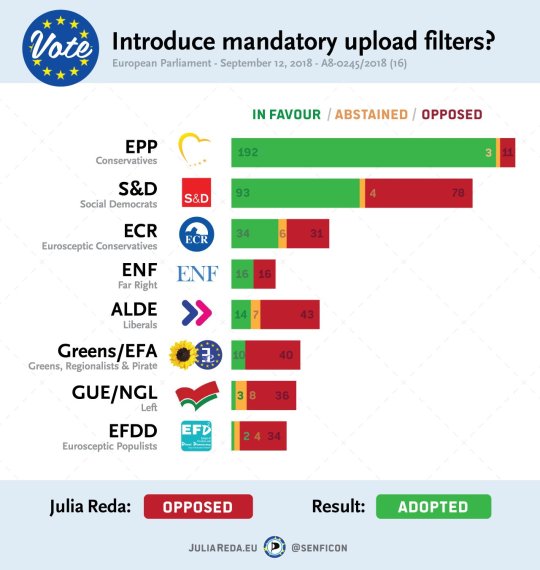
Here’s what the EU voted in favour of this morning:
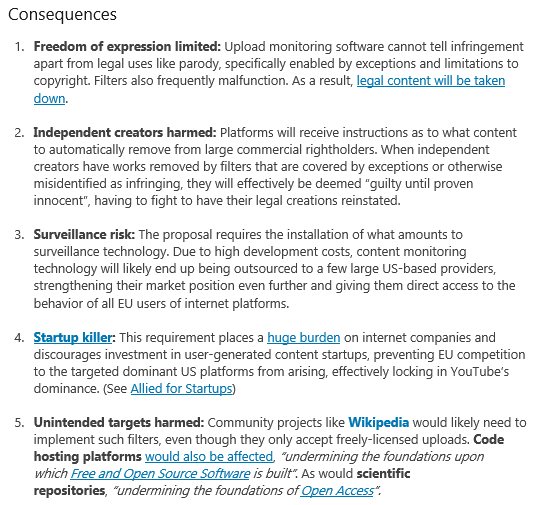
* Upload filters: Everything you post, from short text snippets to
stills, audio, video, code, etc will be surveilled by copyright bots run
by the big platforms. They’ll compare your posts to databases of
“copyrighted works” that will be compiled by allowing anyone to claim
copyright on anything, uploading thousands of works at a time. Anything
that appears to match the “copyright database” is blocked on sight, and
you have to beg the platform’s human moderators to review your case to
get your work reinstated.
* Link taxes: You can’t link to a news story if your link text includes more than a single word
from the article’s headline. The platform you’re using has to buy a
license from the news site, and news sites can refuse licenses, giving
them the right to choose who can criticise and debate the news.
* Sports monopolies: You can’t post any photos or videos from sports
events – not a selfie, not a short snippet of a great goal. Only the
“organisers” of events have that right. Upload filters will block any
attempt to violate the rule.
Here’s what they voted against:
* “Right of panorama”: the right to post photos of public places despite
the presence of copyrighted works like stock arts in advertisements,
public statuary, or t-shirts bearing copyrighted images. Even the
facades of buildings need to be cleared with their architects (not with the owners of the buildings).
* User generated content exemption: the right to use small excerpt from
works to make memes and other
critical/transformative/parodical/satirical works.
Having passed the EU Parliament, this will now be revised in secret,
closed-door meetings with national governments (“the trilogues”) and
then voted again next spring, and then go to the national governments
for implementation in law before 2021. These all represent chances to
revise the law, but they will be much harder than this fight
was. We can also expect lawsuits in the European high courts over these
rules: spying on everyone just isn’t legal under European law, even if
you’re doing it to “defend copyright.”
In the meantime, what a disaster for creators. Not only will be we liable to having our independently produced materials arbitrarily censored by overactive filters,
but we won’t be able to get them unstuck without the help of big
entertainment companies. These companies will not be gentle in wielding
their new coercive power over us (entertainment revenues are up, but the share going to creators is down:
if you think this is unrelated to the fact that there are only four or
five major companies in each entertainment sector, you understand nothing about economics).
But of course, only an infinitesimal fraction of the material on the
platforms is entertainment related. Your birthday wishes and funeral
announcements, little league pictures and political arguments, wedding
videos and online educational materials are also going to be
filtered by these black-box algorithms, and you’re going to have to get
in line with all the other suckers for attention from a human moderator
at one of the platforms to plead your case.
The entertainment industry figures who said that universal surveillance
and algorithmic censorship were necessary for the continuation of
copyright have done more to discredit copyright than all the pirate
sites on the internet combined. People like their TV, but they use their
internet for so much more.
It’s like the right-wing politicians who spent 40 years describing
roads, firefighting, health care, education and Social Security as
“socialism,” and thereby created a generation of people who don’t
understand why they wouldn’t be socialists, then. The copyright
extremists have told us that internet freedom is the same thing as
piracy. A generation of proud, self-identified pirates can’t be far
behind. When you make copyright infringement into a political act, a
blow for freedom, you sign your own artistic death-warrant.
This idiocy was only possible because:
* No one involved understands the internet: they assume that because
their Facebook photos auto-tag with their friends’ names, that someone
can filter all the photos ever taken and determine which ones violate
copyright;
* They tied mass surveillance to transferring a few mil from Big Tech to
the newspaper shareholders, guaranteeing wall-to-wall positive coverage
(I’m especially ashamed that journalists supported this lunacy – we
know you love free expression, folks, we just wish you’d share);
What comes next? Well, the best hope is probably a combination of a
court challenge, along with making this an election issue for the 2019
EU elections. No MEP is going to campaign for re-election by saying “I
did this amazing copyright thing!” From experience, I can tell you that no one cares what their lawmakers are doing with copyright.
On the other hand, there are tens of millions of voters who will vote
against a candidate who “broke the internet.” Not breaking the internet
is very important to voters, and the wider populace has proven
itself to be very good at absorbing abstract technical concepts when
they’re tied to broken internets (87% of Americans have a) heard of Net
Neutrality and; b) support it).
I was once involved in a big policy fight where one of the stakes was
the possibility that broadcast TV watchers would have to buy a small
device to continue watching TV. Politicians were terrified of
this proposition: they knew that the same old people who vote like crazy
also watch a lot of TV and wouldn’t look favourably on anyone who
messed with it.
We’re approaching that point with the internet. The danger of internet
regulation is that every problem involves the internet and every poorly
thought-through “solution” ripples out through the internet, creating
mass collateral damage; the power of internet regulation is that every
day, more people are invested in not breaking the internet, for their
own concrete, personal, vital reasons.
This isn’t a fight we’ll ever win. The internet is the nervous system of
this century, tying together everything we do. It’s an irresistible
target for bullies, censors and well-intentioned fools. Even if the EU
had voted the other way this morning, we’d still be fighting tomorrow,
because there will never be a moment at which some half-bright, fully
dangerous policy entrepreneur isn’t proposing some absurd way of solving
their parochial problem with a solution that will adversely affect
billions of internet users around the world.
This is a fight we commit ourselves to. Today, we suffered a terrible,
crushing blow. Our next move is to explain to the people who suffer as a
result of the entertainment industry’s depraved indifference to the
consequences of their stupid ideas how they got into this situation, and
get them into the streets, into the polling booths, and into the fight.
What comes next? Well, the best hope is probably a combination of a
court challenge, along with making this an election issue for the 2019
EU elections. No MEP is going to campaign for re-election by saying “I
did this amazing copyright thing!” From experience, I can tell you that
no one cares what their lawmakers are doing with copyright.
I’m not here to support G or FB getting anymore breaks, because it always has to boil down to the people, to the users: these platforms, and all media and social media platforms are essential to creative freedom/expression/speech/assembly. Any means to curtail those freedoms (no, Axel Voss, not the end of the Internet – that is hyperbolic) by slapping copyright claims wherever a studio or producer can (and they will) threatens the shutdown of those platforms, affecting those who do not have the means to fight back, affecting their ability to communicate with others.
Imagine if Tumblr were to be sued for all the ‘copyrighted’ material that is uploaded to its site, to the point where Tumblr has no choice but to completely eliminate those works or even the blogs connected with them, which would, ultimately force users off the site for good, thus ending Tumblr. No site wants to pay out millions just to protect a 15 year old’s fan account.
Never mind that the fan’s account is free publicity for XYZ artist and whoever represents them. Never mind the use of hashtags is one of the most effective marketing tools there is, and memes are almost a form of social currency.
The timing for all of this seemingly easily defeated brouhaha – just as the US loses Net Neutrality, an issue that will help ISPs to further bleed their customers – ISPs that, if various mergers go forth, could mean that content creators OWN the ISP as well – and if they want further control of their content by slapping everyone with copyright notices, the capitalist writing is on the wall.
Say goodbye to Youtube, say hello – again – to another age of illegal uploads and downloads.
If it all goes sideways, the people are the biggest losers, especially the smaller content producers and those who follow them. Fan videos, reaction videos, even those allegedly protected under fair use, will likely be eliminated or challenged.
I think it’s important for users to know, however, that it is the services themselves being directly penalised – not the users. So if you made a fan video of an Ed Sheeran song, you’re not going to be targeted, the service you uploaded it to is. I’ve seen too many posts coming out of Europe stating they’ll delete their blogs for fear of being sued over the content. No. Tumblr could be sued, not you (and that could mean the end of Tumblr).
This could get very ugly. Not that the Guardian or other UK papers give a shit. They keep burying it in their tech pages – if they discuss it at all. And US media isn’t covering it at all from what I’ve seen, so if you’re angry that US users aren’t discussing it or the UK even, it’s because no one really knows about it.
However, it’s not just a plenary vote by the European Parliament that will decide the fate of the Copyright Directive. Currently, the legislation is also set to be debated in what are known as “trilogue negotiations” — closed-door discussions between EU legislators and member states. These are intended to speed the process of adopting new laws, but critics say they are opaque and undemocratic. Whether or not the Copyright Directive will be subject to such negotiations is undecided. (The JURI committee voted this morning that it should be, but MEPs have a chance to object next month.) If the trilogues do go ahead, it increases the chances that Articles 11 and 13 will become law. “[The legislation] is much less amenable to being rejected after this process,” says McNamee.
If the legislation is passed in its current form, it would have a devastating effect. Article 13, for example, would require the creation of an automatic filter for all online content uploaded in the EU, checking it against a database of copyright licenses. The system would be costly to create, impossible to keep up-to-date, and easily gamed by copyright trolls. And, as experts including Tim Berners-Lee and Jimmy Wales have warned, it would turn the internet into a “tool for the automated surveillance and control of its users.”
As of July 4th 2018, the Internet as we know it might be dead for good.
The European Parliament is passing a new Copyright Directive. Article 13 #CensorshipMachine will impose widespread censorship of all the content we share online. Art, fanfiction, parodies, remixes, mashups, memes, etc.. Anything that you do not hold the rights over will be taken down.
Article 13 would force all online platforms to police and prevent the uploading of copyrighted content, or make people seek the correct licenses to post that content. Internet platforms hosting large amounts of user-uploaded content must monitor user behaviour and filter their contributions to identify and prevent copyright infringement.
Such filters will be mandatory for platforms including YouTube, Facebook, Tumblr, Reddit and Instagram, but also much smaller websites.
Last Tuesday (19th June 2018) a group of more than 70 people who have played important roles in building the internet and developing it (Tim Berners-Lee, Vincent Cerf,
Jimmy Wales, Mitchell Baker…) into what it is today addressed an open letter to the members of the European Parliament:
“As creators ourselves, we share the concern that there should be a fair distribution of revenues from the online use of copyright works, that benefits creators, publishers, and platforms alike.
But Article 13 is not the right way to achieve this. By requiring Internet platforms to perform automatic filtering all of the content that their users upload, Article 13 takes an unprecedented step towards the transformation of the Internet from an open platform for sharing and innovation, into a tool for the automated surveillance and control of its users. […] The damage that this may do to the free and open Internet as we know it is hard to predict, but in our opinions could be substantial.”
This story has been more or less buried due to far-right pranksters who tried to make it look like a joke. But it isn’t.
Anyone who thought only America would have a censored Internet after Net neutrality doesn’t realise how there is a domino effect when right-wing groups, major corporations and billionaire individuals start to take over. They don’t want criticism. They don’t want to be questioned. Monopolies persist. Human rights violations. War games. The lowering of public standards and civil discourse. The spread of poverty. Racism without consequences. The removal of legal protections of citizens and the environment. The diminishing of democracies.
Reminder: Americans lose access to a free and open internet next month. Do not be surprised if some voices on here disappear. Do not be surprised if other countries begin to follow suit.
Or you could try to do something about it, like calling your representatives or taking to the streets if all else fails.
Attention fanfic writers: If you use Google Docs to write/store/back-up your fics, you might want to download anything you don’t already have backed up elsewhere. Google is apparently invading and deleting people’s personal drive content thanks to the FOSTA/SESTA bill that recently passed through Congress. Essentially, it criminalizes ANY platform where sexual content could be placed.
It may also be worth making sure you have offline back-ups of any and all fics you have posted here on Tumblr and on AO3, in case Yahoo get antsy (they’ve been cracking down on the porn bot tumblrs already) and OTW face a legal challenge to take down AO3. I’m hoping that’s not the case – but I was on LiveJournal during Strikethrough in 2007 and I remember the way that whole communities as well as individual LJ accounts were deleted and purged; it was instrumental in the founding of AO3 in the first place. That was a widespread purge of fanfic writers and communities, LGBT+ communities and writers and more, all due to legal threats that SixApart, the company that owned and hosted LiveJournal, received due to allegedly hosting paedophile content. After Strikethrough was over and LJ admitted they’d gone OTT, there were a number of communities and accounts that didn’t get reinstated. I’ve always been quite careful not to have my Tumblr flagged up as NSFW in part because of that. Given the number of Facebook accounts that get temporary or permanent suspensions thanks to malicious false reports, I have very little confidence that Tumblr’s staff won’t make mistakes.
I’m not sure what this means for collaborative fics; but Google Docs probably aren’t a safe platform for that anymore.
If you thought the end of net neutrality in the US wouldn’t affect you, guess again.
Democracy is being dumped all over, and there’s hardly a conversation about it on this site or anywhere.
You all do realise when those new rules go into effect this will see the end of free speech and freedom of expression? It might not happen all at once, but it will happen. It will happen when no one takes to the streets over it. It will happen when the first person to pay their new internet bill doesn’t bother to question it.
You think it won’t happen, it can’t happen, someone will do something.


 The Doctor Is Out