jalehh:

commanderoswald:

This video essay is about a gendered trope that has bothered me for years but didn’t have a name, so I gave it one: Born Sexy Yesterday. It’s a science fiction convention in which the mind of a naive, yet highly skilled, girl is written into the body of a mature sexualized woman. Born sexy yesterday is about an unbalanced relationship, but it’s also very much connected to masculinity. The subtext of the trope is rooted in a deep seated male insecurity around experienced women and sexuality.

Note that Born Yesterday isn’t meant literally. Born Sexy Yesterday can be written literally but it doesn’t have to be. If media uses a “fish out of water” plot to frame an adult woman as an inexperience child then it fits the trope.

If you want to discover a new – and very disturbing – trope you might not have known about but that is wildly prevalent in the way men write women in media, especially in science fiction, watch this video. Then go give the comments a read and take a look at how fragile men’s egos are. 

I guess that explains why I shipped B’Elanna/Seven and very much disliked the doctor. 

I’m glad he pointed out how the various iterations of Star Trek played with this trope – a lot (one of the worst: in ‘The Perfect Mate,’ Captain Picard meets a woman who, as written, is literally born with the ability to know what pleases individual men and…make it so.  Of course she ‘bonds’ with him – a much older male – and would be his ‘perfect mate’ – except she is intended for another man).

This trope is, essentially, built around the older man/younger woman theme that is older than the hills, so there isn’t much new, but it is so rarely articulated, especially how it is presented in science fiction, so this makes a nice change.  

I wish he’d included Doctor Who in this discussion, especially since the 2005 renewal, as The Doctor has been often portrayed as the object of desire of his much younger and female companions – some of whom he meets as children (Amy, Clara, River) and influences the course of their lives. That these women become besotted with him and (for a time, at least) live – and even die – for him, adds another layer of disturbing sexism to a show that really needs to address the issue (just as it recently addressed the whitewashing of history).  

I’m also curious to see how a variation of this trope plays out in the upcoming Wonder Woman film (Princess Diana as the naive outsider being guided by manly Steve Trevor).  

emilysidhe:

ami-angelwings:

I remember when I was reading that story as a kid, Sherlock goes on and on about The Woman, the only one who ever beat him, and you’re thinking, he’s had better villains than this. And then you click: he fancies her, doesn’t he? That’s what it’s about.

– Steven Moffat on A Scandal in Bohemia.

That quote from Moffat that I just reblogged made me think of something about the way most adaptations have handled Irene Adler and Moriarty.

In the original stories, Adler wasn’t a plot device, she was the adversary in the mystery that matched wits with Holmes, outsmarted him, and that he respects greatly at the end.  While she’s still a character in the story, she doesn’t exist for Holmes, and she comes up with a solution to the dilemma that’s actually superior to his.

But Moriarty existed purely as a device for Arthur Conan Doyle to get rid of Holmes.  He had to create a reason for Holmes to be willing to sacrifice himself, so he created Moriarty who was given this big criminal past and was said to be super smart.  The story itself really didn’t show him being particularly smart, and most of what sets him up is just told to us.  At the end he ends up being tossed off a cliff by Holmes after Holmes has ruined his empire.  He’s completely a plot device, his entire raison d’etre in the story is focused around Holmes, and to get ACD from point A to point B which is having Holmes die a hero’s death that hopefully the fans would accept.  He wasn’t Lex Luthor, he was Doomsday.

Adler didn’t exist as a plot device, she didn’t revolve around Holmes, and she got what she wanted at the end.  Moriarty existed just to facilitate Doyle getting rid of Holmes, everything he does in that story revolves around Holmes, and Holmes gets what HE wants at the end (even without Holmes coming back to life, it had already been established Holmes was prepared to die to get rid of Moriarty).

Yet in almost every adaptation, it’s the opposite.  Adler is the plot device, she’s a romantic interest, she’s a hostage, she’s the fake out, she’s the bait, etc… and Moriarty is the active agent who is smarter than Holmes and outwits him (at least until he’s defeated) and that Holmes respects as an equal.  Adler tends to exist for Holmes, revolves around Holmes, and Moriarty is the greater character with his own story.

The Moffat quote makes me wonder if many boys (him included) grew up reading A Scandal in Bohemia, rolling their eyes and going “stupid chick, he probably let her go just because he likes her, why else would he think she’s so great?” while reading the much less fleshed out Moriarty who Holmes defeats and going “WOW WHAT A COOL BRILLIANT DUDE!  HE’S SO SMART AND AWESOME.  WHAT A WORTHY FOE.”  Even though he’s not shown as being so, he’s just said to be so, but he’s a man and he captured the imaginations of boys reading the story, while she’s a woman and they fit her into a slot for women characters (and how women are seen in relation to men in society) and dismissed why she had won such profound respect from Holmes.  So when they grew up and wrote the adaptations that now shape how people see these characters, their biases changed the way the characters were represented, and also the way people now see them.

Yes!!!  Also?  Yes, Holmes has had better villains than this whom he didn’t have much trouble defeating AND Irene Adler’s one of very few people who’ve ever defeated him and it IS because she’s a woman, but not because he’s too attracted to her to think???  It’s because he massively underestimated her due to paternalistic sexism!  Moriarty has no chance against Holmes because against the male math genius with the criminal empire, Holmes brings his A-game.  But when faced with a female opera singer, he totally half-asses it.  You can tell while you’re reading that he’s treating the whole Irene Adler case as a joke right up until the moment when she righteously smacks him down and it’s glorious.  So glorious that he practically thanks her for the privilege!

But of course so many men can’t see sexism in our own society unless it’s in their face twirling a mustache, so they read this story and they don’t see the obvious signs that Holmes didn’t take her seriously until it was too late because she was a girl, they just see that she outsmarted him when she probably shouldn’t have been able to and go, “Ah, I’ve seen this plotline before, it must be the feminine wiles.”  Because it never occurs to them that their own thinking might be colored by unconscious biases, much less that the great logician and unbiased reasoner Sherlock Holmes could be susceptible to the same weaknesses.

Eloquently deduced.

suprasternalnotsh:

inspectorboxer:

normalgiraffes:

Something I’ve noticed is that when we criticize Mon, someone always jumps into the notes to defend him. And the way they defend him is always the same – “well, he’s new to this planet, he doesn’t know how things are here!” / “he’s still learning, give him a chance” / “Well, but Kara likes him that’s all that matters” / “He lost his whole planet he’s probably traumatized” / “When he choked Kara and threw her through a window, he was scared and confused because he’d just woke up” / etc.

But here’s the thing: he is not any of those things. People are defending him as if he is a real person. He is not.

When we criticize Mon, we are not criticizing him as a person, because he isn’t one. He is a fictional character. We are criticizing the way he is being written. We are not angry at Mon the person because he does not exist.

We are angry because on a television show about a female hero, one marketed toward young girls, we just got an episode where two men fought over which one of them Kara belonged to, completely disregarding Kara’s agency and (lack of) consent.

We are criticizing the writing because we have yet to see a single reason why Kara likes him, or why he is somehow worthy of her, because his attraction to her, and him feeling bad because he thinks she doesn’t like him is not, by any measure, a reason why she should return that affection. As written, her interest in him is completely inexplicable, other than the fact that the actor playing this character is conventionally attractive. That’s not me saying “Mon is a terrible person and Kara doesn’t even like him”, because again, he’s not real. That’s me saying “The writing this season is terrible.”

We are critical of his character because, as we learned last season, they can easily write a character being confused on Earth, and not understanding how things work without writing the character as an admitted misogynist.

We are critical because if they wanted to show a character being scared and confused, there are dozens of ways to do that without him violently assaulting his future love interest, but they chose to write it this way.

We are criticizing the writing because if they wanted to show a relationship between two characters from different worlds, they could have done that with James and Kara, because James is from Earth and Kara is from Krypton. But they chose to suddenly and abruptly break up a relationship that they spent an entire season establishing and still haven’t adequately explained why in the story, and put Kara in a romantic relationship with Mon instead.

Mon isn’t real. He is a fictional character. We aren’t angry at him, because he doesn’t exist. We’re angry at the systemic culture of misogyny and racism, where the writers and producers and network executives think breaking up an interrracial couple after a season-long slow-burn before they even have a date so they can bring in a white guy; where the writers may have intended to write a brash hero, but think that means he should belittle and humiliate his love interest, our title character; where nobody seemed to have stopped to think “perhaps we should not have our future male romantic lead violently assault our female lead in a manner extremely reminiscent of domestic violence in a show aimed at young girls?”; where nobody seems to have stopped to think, period.

Look. I get that people who ship it think Mon is handsome, and that you think he just needs to be given a chance and he’ll change for Kara because he loves her so much. But he’s not real. He’s not capable of that, because he doesn’t exist. You can’t remove him from the context of the world we live in, because fiction doesn’t exist in a vacuum, and a show for young girls about a female hero normalizing that this is what romantic relationships should be like is incredibly irresponsible, and just plain bad writing.

There are hundreds of different ways they could have written this character. They chose to write him as a misogynist. They chose to take the romantic lead role away from the black man playing a beloved character, and give it to the new white boy instead. They chose to show our new romantic lead being physically violent to our female lead on more than one occasion – and specifically showed her being physically vulnerable to his strength (the scene where he chokes Kara and throws her through a window? Watch it again. He chokes her with one hand, picks her up by the throat and throws her with one hand – as Kara struggles and uses both hands to try to free herself and can’t, watch Kara on the ground as he kicks her in the stomach, sending her body sliding clear across the room). They chose to show him treat Kara as a prize to be won. They chose to write it in such a way that it, at best, is something very close to emotional abuse. They chose to show him disrespecting Kara. And they chose to have Kara be interested in him. They chose to sideline Supergirl in her own show (the only plot Kara has this season is supporting Mon).

They did not have to write him this way. But they did, and it’s reprehensible and irresponsible.

So, no. I don’t hate Mon. He doesn’t exist. What I do hate is every single one of the decisions made by the writers, producers and network executives that led to them thinking this was how to write a romantic relationship. It isn’t.

How many young girls will aspire to this kind of relationship because of this show? How many will be treated cruelly and think it’s just the way things work in relationships because of the message the writers are teaching them? Shows have shoved this nonsense down people’s throats for decades. It’s not revolutionary, it’s not cute, it’s not “banter” as the EP calls it, it’s damaging. They could literally be harming young woman with this story line. Whoever is responsible for turning a show about empowering women into a show about treating them poorly needs to be fired.

As they like to say in comics, with great power comes great responsibility. The Supergirl writers need to start taking some for their actions.

It is not only young girls who will be affected by this irresponsible portrayal, those who will be impacted the most are actually young guys watching this show, as I am sure there are plenty who still do, despite the perceived negative connotations a of a female superhero show.

What the majority of the US based online fandom does not seem to be fully aware of, is the fact that this show is being broadcasted in other areas of the world, alongside the other superhero shows from the same network. It is reaching a wide spectrum of viewers, from different cultures and backgrounds. If anyone is still under the illusion that media, precisely superhero themed media content, is not influential and essential in shaping one’s perception and outlook on life, especially among teen and younger viewers, then well, I feel sorry for them.

Nowhere this influence is more crucial than in patriarchal and conservative societies. Turning on the tv and seeing a genuine female superhero, the main star of a show, a lone girl on the show’s poster, that is not something trivial, common or inconsequential. This is a show that is shaping the imagination of young girls and boys from my region, who are not being brought up in the same environment and culture as US viewers,
who have not grown up with superhero comics,

who lack real life role models, and who, despite an easier access to the internet with its infinite content, are still enamored with comic book heroes, who still turn up in huge numbers to watch DC and Marvel movies anytime they get released.

I am worried about these viewers more than any others. These mostly young guys will tune in to watch the latest episode on a cable network that broadcasts to millions of subscribers in more than a dozen countries, think HBO but bigger. These young guys and girls will continue to be subjected to this toxic semblance of a romance, all the while the message that their mind is processing is that the patriarchal practices that they are witnessing first hand in their societies, the objectification of women, the misogyny, the verbal and physical abuse, the remaining horrible traits that this male character is exhibiting, all these features are being normalized, justified and ignored in the narrative, all in favor of the MALE love interest, at the expense of the FEMALE superhero. 

So no matter where the writing ends up taking Kara and Mon-El’s relationship, the damage that has been inflicted on the show’s image, its message, its core values, in the aim of imposing this relationship, through heavily marketing it as a counterpart to the other main couple of the show, that damage is permanent and irrevocable. Its negative ramifications cannot be swept away with a convenient “cautionary tale” twist. Kara’s character was literally obliterated in order to accommodate for the insertion of a “white male savior”, the Danvers Sisters dynamic, the literal heart and soul of the show, has been dismantled to further facilitate this insertion. These atrocities and all the other messed up storylines, plot holes, bad characterizations and missing development are supposed to be resolved how exactly? During a few minutes of exposition between fight scenes?

No, the big twist escape route will not do, the writing has become irresponsible, inexcusable and downright unethical. If even just ONE impressionable viewer stops watching, misses out on this supposed twist and comes away from the show with a distorted view of “romantic” love, with a mental image of a “weak” female superhero reduced to being the typical damsel in distress, or with a reinforced sense of male entitlement, that’s all it takes to negate any moralistic lesson or absolution that the writers might intend to flesh out for either Kara or Mon-El. Cosmetic fixes in the narrative won’t achieve any remedial effects and frankly, seeing their track record, the current writers are highly unqualified for the task and have run out of adequate screen time to salvage the show before this season ends.

This is the kind of discussion that is so inspiring because it shows the audience is active.  The audience can and will participate in the critical commentaries on these programmes and will make noise and bring attention to the failings of an entire industry.  

We saw it last year when the Clexa fandom rose up to challenge the industry, how that spread through other fandoms to demand better and here it is, now, with Supergirl. 

Keep these discussions going, make the industry pay attention to you.  Make them notice and care and change – or find their work, their money, their effort, for naught. 

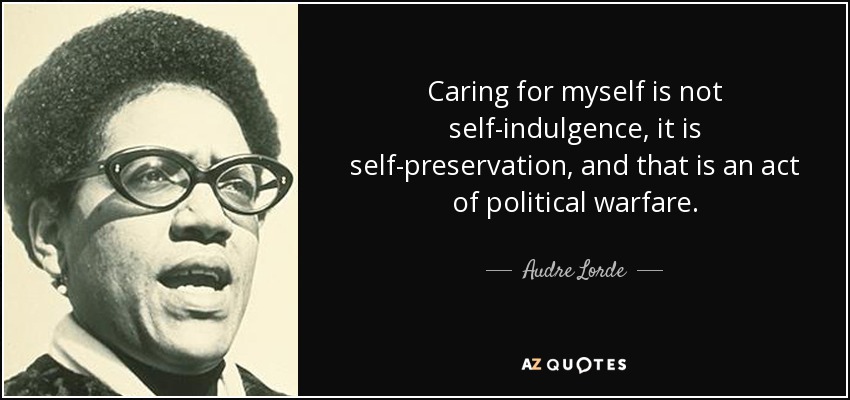
Appropriating Audre: On The Need to Locate the Oppressor Within Us | Bitch Media

fuckyeahlesbianliterature:

The worst kind of appropriation of Audre Lorde is taking place these days by folks who use her quotes (out of context) to serve their own anti-intersectional projects. As self-care has become a trending topic in social-justice circles, different venues have taken up Lorde’s famous saying on self-care without critically reflecting on how Lorde’s need for self-care stemmed from living and surviving under racist heteropatriarchy.

THIS.

Appropriating Audre: On The Need to Locate the Oppressor Within Us | Bitch Media

I wonder about men, and their lives away from women, and their societies that we are not allowed in;
 
do you text each other “are you home safe” at the end of the night? do you only go out in pairs, arms linked, a promise to make sure that you are both safe. do you have to drink before each party because every offered cup is a looming threat. do you escape to bathrooms to whisper sharp warnings about a girl’s previous relations.
 
when the morning comes do you talk about what he did with a hurried, excited voice; mock-appalled at his scandalous behavior. do you ask him about it, do you sit for hours picking apart her text messages and what she meant when she didn’t call until long after ten.
 
when you go into your man-caves, man-room, man-hole; do you talk about women carefully, respectfully, with constant forgiveness – do you let your friends say things you pretend you don’t agree with? when we aren’t around, do you defend us? do you let him call names from his window, do you slide his eyes off his mistress, do you chuckle and sip beers and try not to think you’re one of them?
 
what do you do in the quiet moments where women are screaming? do you turn your head from the bad things? do you forward the video on krav maga to your sister, do you stand between strangers? when she says her boyfriend – your friend – is an abuser, do you believe her, or him? do you look at the bruises and say she must have done something wrong to get this from him? when you know in your heart of hearts he is not good to women, do you do something?
 
when you walk home do you keep keys in your fist. do you dress specifically in the hopes you won’t get attacked if it’s too close of a fit. do you avoid enclosed spaces, do you constantly scan for threats. do you flick the news off, knowing they won’t be talking about whether or not your body is punishable under the law. do you worry about the one in four of your sisters who will be raped, or is it a small fact, a kidney stone only, annoying but survivable. do you say rape culture isn’t a thing, laughing; do you make sure your daughters don’t go outside in flattering dresses for the same reasons you refused to admit exist. do you promise you’re a feminist, stop there, not worry about the intersectionalist portion of it. do you need to worry about it? are you doing good enough just identifying by it?
 
and men, what happens to your heart when you cannot hug another. what happens when you want to love but your father’s voice is in your head like a wall of thunder. what happens when your passions are in things traditionally feminine. who tells you it’s okay and that you’re still a man. do you push down the tears because it’s easier or because it’s harder? when she cries, do you feel jealous of her?
  
men, in the lives so public; always flashing in tv, bulky, lean. men with their opinions and their secrets. but what is it, to be free like that, to be unworried, to never watch a tongue when it starts walking. are you happy? do you fear marrying someone who will emotionally detach three years in, who will spend her life hidden from you, drinking. do you fear lonely nights where all she wants is a hushed thing and then to bed, before you are crying. do you fear travelling alone, do you fear a room full of women? do you fear anything?
 
what is it like in there? What are men when no one is looking?

r.i.d (via inkskinned)

Good instinct to publish

skinnymeme:

the whole culture that has grown around making fun of girls for literally everything never fails to amaze me….oh you like to paint? you’re a pretentious art hoe. you like reading? god, i bet the only thing you’ve read is cheesy romance novels. you like music? lol yeah right have you ever even heard of – insert boring white rock band from the 70s -. you wear makeup? you’re fake as fuck. no makeup? damn you look sick, at least put some foundation on. snapchat filters? basic. small boobs? gross, you look like a guy. big boobs? ew why are they sagging and why do you have stretch marks ugh. haven’t had sex? what a prude, loosen up. oh you have had sex? you’re a fucking slut!! you can’t win. you literally can not win.

All the more reason not to be victims of patriarchy, but do all we can to dismantle it completely.

fuckyeahwomenfilmdirectors:

insanely-smart:

asmallcoat:

diebrarian:

lesbianrey:

george lucas directed star wars (1977) after only making one studio film but ok kathy

(1 2 3 4)

This is absurd??

There’s also been a great response to this in Forbes.

http://www.forbes.com/sites/scottmendelson/2016/11/28/female-directors-dont-need-experience-they-just-need-to-get-hired/#3380279f23a3

@fuckyeahwomenfilmdirectors

I saw this when it was first reported and was going to ignore it because it is so patently stupid and wrong, but what the hell, since someone @’d me I’ll throw my two cents in: THIS IS COMPLETELY STUPID AND WRONG.

Again this is really indicative of a culture in which women are held to higher standards than men that complete bullshit because no matter what standard you hold a woman to there are women that actually fit that criteria and are getting ignored anyway. 

If you only want to consider a woman who has done big budget scifi/action before: Patty Jenkins, Lexi Alexander (WHO HAS SPECIFICALLY EXPRESSED INTEREST IN THE STAR WARS FRANCHISE), Mimi Leder, Anna Foerster, Ava DuVernay (not even going to include the Wachowski sisters or Kathryn Bigelow because they are so obviously overqualified it’s ridiculous).

If you only want to consider women who have done mid-tier (between 20-60 million budget) movies: Julie Taymor, Karyn Kusama, Catherine Hardwicke

If you only want to consider women who have done low-budget scifi/action or TV so you can cultivate their talent: Michelle MacClaren, Jennifer Phang, Ana Lily Amirpour, Jennifer Kent, Mary Harron

This holiday season, instead of blindly throwing your dollars at Star Wars see one of the many great indies out there directed by women. Because you need to support the films they are making right now instead of hoping that one day a producer might wake up and toss one of them a bone. 

Here’s some more (might not be associated with SF, but when does that stop the inexperienced boys?): 

Gillian Armstrong, Agnieszka Holland, Talya Lavie, Mira Nair, Jane Campion, Susanne Bier.  

Might be interesting to see how a non-SF filmmaker makes a SF film. 

Kathleen Kennedy: shame on you. 

thanks for the reading ideas i’m definitely going for some. do you have some thoughts though on why so many books movies and tv LOVE killing off the lesbians? i’ve read about the bury your gays and i get that but it doesn’t stop. It’s like everyone loves this idea.

Glad you enjoyed the reading recs. 🙂   

I’ve too many ideas on the dead lesbian topic, so much of the fascination with it goes back decades, to 50s pulp fiction, to lesbian vampire stories and later films (probably the most responsible for romanticising the image).  

In the past, the dead lesbians were villainous, predatory beings who ‘got what they deserved.’  In more recent media. starting in the 90s (when we saw the first major ‘coming out’ of well-known lesbians and gays), the imagery shifted from ‘villainous’ to ‘tragic’ characterisations, such as the lesbian founders of the fictional town of Cicely in an episode of Northern Exposure, or the heroic but ultimately tragic downfall of Xena, to the lovable and gentle Tara, victim of a stray bullet that helped push her girlfriend, the problematic anti-hero, Willow into broken villain territory.  

Films like High Art with Ally Sheedy as a drug addicted photographer on a downward spiral and Lost and Delirious helped reinforce the tragic lesbian image: the troubled, lovelorn and usually misunderstood loner who cannot be with the one they love (or finds their love unrequited – another common thread).  

We can make connections in real life: lesbians so often seen as something undesirable, preying on young girls, undeserving of love, on the receiving end of public violence.  It’s as if media makers cannot see past this view, cannot think there are other ways to present lesbian lives.  

Dramas like Chasing Amy frustrated lesbians and bisexuals with the characterisation of the allegedly lesbian (yet straight-presenting) cartoonist/writer who fell in love with a man (another common trope: the lesbian who just needs the love of a good man to see the error of her ways) and found herself ostracised by her friends and mocked by her boyfriend’s best friend (who doesn’t believe in ‘man-friendly lesbians’ there are only ‘man-hating dykes.’).  

Again, we see the problematic view of straight versus our own, personal narratives that would offer a completely different take.

It’s hard to look at the romanticising of tragic lesbians without recognising that there is an element of the classic romanticising of tragic male heroes built-in.  As if lesbians become a stand-in for the classic male hero who pines for a love that cannot be had and, possibly, dies in the end.  There are many examples of male characters written in a similar fashion (it’s practically the history of all literature/film-making) and it speaks loudly that so many filmmakers/show runners who create a lesbian character/pairing, are straight (white) males.  Instead of writing a lesbian as a lesbian, they write her as a the tragic male hero archetype.  

It’s a powerful image, it is prevalent and systemic throughout all media and it is difficult to shake.  We have women who write this trope.  We have women writers who compose stories like Twilight and 50 Shades of Grey that romanticise abuse.  Is it no coincidence that these type of stories get made into films while more direct lesbian narratives in fiction, like Malinda Lo’s Ash or Emma Donoghue’s Stir Fry do not?  With the possible exception of Sarah Waters, lesbian writers do not typically see their lesbian-themed works on screen.  

There is another, more uncomfortable angle of this problem (that would likely involve my doctoral thesis) that looks more broadly at women with mental illness and how they are perceived in society. Women who suffer from mental health disorders are rarely portrayed in the same light men suffering from similar issues or, say, PTSD are: how many films have been made about soldiers returning from war, behaving in violent, abusive or otherwise disturbing fashions are treated (and often rightly) with sensitivity and heroism, while women with similar issues are either non-existent or ignored.  

Case in point: Willow, from Buffy the Vampire Slayer,

had been a somewhat insecure but brilliant and magical student who became Buffy’s ‘big gun’ when up against the hell god, Glory.  She is on her way to hero-dom.  Almost immediately thereafter she suffers from ‘magic addiction’ that leads her to mind-rape her girlfriend Tara, abuse her friends and, eventually, to murder. When Tara is killed, she goes on a murderous rampage that is only resolved when her (male) friend, Xander, is able to talk her out of it.  She is later handed over to another male father-figure, Giles, who treats her gently, but with the kind of paternalistic heroism that deflates her considered prowess (and potential) into problematic territory where Willow becomes afraid to use her magic at all and once again becomes an insecure sidekick (albeit one with almost godlike powers).  

Characters like Willow can drive home the point that no matter what do, what we are capable of, as women (and as lesbian/bisexuals), will always be secondary to our problematic emotional states that lead us down troublesome roads where a good man would really come in handy.  

If there is to be a hero, someone must be rescued and, for the male-centric paradigm of our culture, that someone is preferred to be a female.   

It goes hand-in-hand with my belief that a major reason we don’t see many female superhero action figures is that there is a perception that boys will not play with them.  The reason we see girls dressed as male action heroes (for fun or Halloween) while boys are never seen dressed as female action heroes: women are not perceived as worthy as men for any significant social standing, least of all as cool heroes (that this perception revolves around so many young men and boys is also troubling).   

For many years the programme Doctor Who teased the possibility of a female Doctor.  This notion was vociferously put down by fans (largely male, but women too) and, I feel, an aspect of this is the same as written above: boys will not follow women and will not wear a woman hero’s costume, even for fun.  The boys will dress up as boys and play with boy action figures, but they will not show the same respect for female figures.  As marketing toward males is considered the strongest demographic, once again, women are belittled just for being women.  

I know I’m writing this rather simplistically, but I feel much of this information is so broad anyway and so many citations are available almost anywhere.  There are some common truths in our society: women CEOs are rare, women directors are not hired, lesbians are perceived through a male filter equating them with tragic and even mentally ill figures.  

It makes programmes like The 100 so much more disappointing when, after achieving the astonishing feat of creating story lines for complex women as leaders and heroes, they begin to fall into the trap of ‘redistributing the wealth’ so that the (background) male characters may take centre stage and reaffirm their own complex hero status, usually at the expense of a female character’s development (see the troublesome nature of Clarke and Bellamy’s relationship).

We exist to be sidelined, the story seems to be and while I acknowledge that the world has made some extraordinary strides in its (evolutionary) understanding of women, on the small screen as well as globally, in real life, the formulae for success seems to point to male-centric demagoguery.  Is there a more potent or disturbing example of this than, say, Donald Trump’s presidential campaign?  We seem to have reached peak toxic maleness at this point.

We have made progress, though.  Social media has helped open the hearts and minds of so many who would remain ignorant of the reality of female Muslims or the disabled or of transgender concerns.  It doesn’t prevent backlash, of course.  Trump would have Muslims banned.  The disabled are so rarely seen in film or television (and when they are, they are usually portrayed by non-disabled actors).  POCs are still singled out for murder by public authorities.  LGBTQs are still seeking positive representation.  

It is, therefore, heartening when audiences come together to complain about issues like queer baiting and lack of representation.  It is heartening to see social media campaigns that call out the tokenism that is still rampant in our lives. We deserve better and we know it.  We’re not settling for standard-issue formulaic drama that still promotes the hetero normative as positive while anything different is subject to trope-ish cliches.  We are, rightly, demanding that the media world diversify and write better stories, not just the ones that highlight one portion of society as normal while everyone else becomes a controversial bystander.  

I didn’t mean to rattle on, and hope some of this makes some kind of sense.  Thanks for writing!